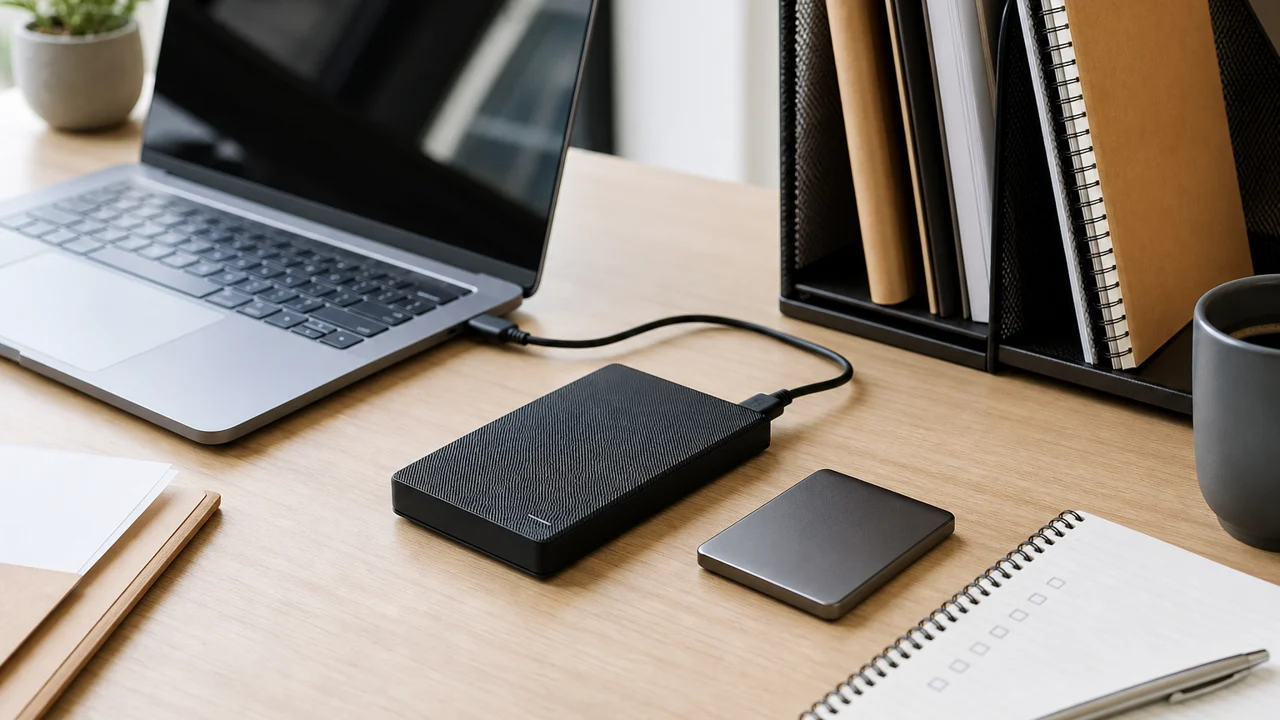
A capacity planning works best when it starts with real office behavior. Many teams buy storage after a laptop warning, a full photo folder, or a project handoff. The better approach is to map what files matter, how often they change, who needs them, and how painful restoration would be if a computer failed tomorrow.
This guide is editorial buying help, not a claim that one device solves every backup risk. External drives are useful for local copies, archives, handoffs, and quick restores, but they still need a habit around them. A drive sitting unplugged in a drawer is not the same as a backup system.
Start with what would hurt to lose
For external hard drives in an office, the useful choice depends on capacity, connector, portability, speed, and how easy the drive is to label and store. A designer moving large media files has different needs from a bookkeeper archiving PDFs, and a shared reception computer has different risks from a travel laptop.
Think about the whole path: plug the drive in, run the backup, confirm the folders are readable, disconnect it safely, and store it somewhere sensible. The best drive is the one your office will actually use every week, not just the model with the biggest number on the box.
- Keep at least one important copy away from the main computer.
- Use clear folder names and backup dates.
- Test that files can be opened before relying on the archive.
Choose capacity for versions, not just today
For external hard drives in an office, the useful choice depends on capacity, connector, portability, speed, and how easy the drive is to label and store. A designer moving large media files has different needs from a bookkeeper archiving PDFs, and a shared reception computer has different risks from a travel laptop.
Think about the whole path: plug the drive in, run the backup, confirm the folders are readable, disconnect it safely, and store it somewhere sensible. The best drive is the one your office will actually use every week, not just the model with the biggest number on the box.
- Keep at least one important copy away from the main computer.
- Use clear folder names and backup dates.
- Test that files can be opened before relying on the archive.
Match drive type to the job
For external hard drives in an office, the useful choice depends on capacity, connector, portability, speed, and how easy the drive is to label and store. A designer moving large media files has different needs from a bookkeeper archiving PDFs, and a shared reception computer has different risks from a travel laptop.
Think about the whole path: plug the drive in, run the backup, confirm the folders are readable, disconnect it safely, and store it somewhere sensible. The best drive is the one your office will actually use every week, not just the model with the biggest number on the box.
- Keep at least one important copy away from the main computer.
- Use clear folder names and backup dates.
- Test that files can be opened before relying on the archive.
Make the routine boring and repeatable
For external hard drives in an office, the useful choice depends on capacity, connector, portability, speed, and how easy the drive is to label and store. A designer moving large media files has different needs from a bookkeeper archiving PDFs, and a shared reception computer has different risks from a travel laptop.
Think about the whole path: plug the drive in, run the backup, confirm the folders are readable, disconnect it safely, and store it somewhere sensible. The best drive is the one your office will actually use every week, not just the model with the biggest number on the box.
- Keep at least one important copy away from the main computer.
- Use clear folder names and backup dates.
- Test that files can be opened before relying on the archive.
Protect private files in transit
For external hard drives in an office, the useful choice depends on capacity, connector, portability, speed, and how easy the drive is to label and store. A designer moving large media files has different needs from a bookkeeper archiving PDFs, and a shared reception computer has different risks from a travel laptop.
Think about the whole path: plug the drive in, run the backup, confirm the folders are readable, disconnect it safely, and store it somewhere sensible. The best drive is the one your office will actually use every week, not just the model with the biggest number on the box.
- Keep at least one important copy away from the main computer.
- Use clear folder names and backup dates.
- Test that files can be opened before relying on the archive.
Keep restore day in mind
For external hard drives in an office, the useful choice depends on capacity, connector, portability, speed, and how easy the drive is to label and store. A designer moving large media files has different needs from a bookkeeper archiving PDFs, and a shared reception computer has different risks from a travel laptop.
Think about the whole path: plug the drive in, run the backup, confirm the folders are readable, disconnect it safely, and store it somewhere sensible. The best drive is the one your office will actually use every week, not just the model with the biggest number on the box.
- Keep at least one important copy away from the main computer.
- Use clear folder names and backup dates.
- Test that files can be opened before relying on the archive.
FAQ
Should an office choose SSD or HDD?
SSD is usually better for speed and travel; HDD often gives more capacity for less money when the drive mostly stays on a desk.
Should backups be encrypted?
Encryption is worth considering when a drive contains client files, staff records, financial documents, or anything that may leave the office.
Related guides
Capacity planningSSD vs HDDBackup routineFile organizationSecurity basicsBuying mistakesPrevious cloud article: surge protector guide